Navigating Granular AI Video Analysis Through the Lens of Markus Eder’s The Ultimate Run


The intersection of artificial intelligence and digital media processing has reached a critical inflection point, forcing developers and engineers to reconsider how video assets are parsed, indexed, and queried. In the modern computational landscape, processing high-definition video data efficiently remains one of the most resource-intensive challenges for AI infrastructure developers. To address this computational bottleneck, video infrastructure platforms are adopting multi-layered parsing strategies that segment media into discrete, context-aware units. A prime pedagogical example of this architectural necessity is found in the analysis of high-motion, visually dense media assets, such as professional action sports films.
The Computational Overhead of Modern Video Processing
Analyzing long-form video content at scale presents a severe resource challenge. A standard one-hour video encoded at 30 frames per second yields approximately 108,000 individual frames. Feeding every individual image into a foundational vision model is computationally prohibitive, highly expensive, and frequently inefficient. A vast majority of consecutive frames contain redundant visual data that adds zero contextual value to an AI query engine.
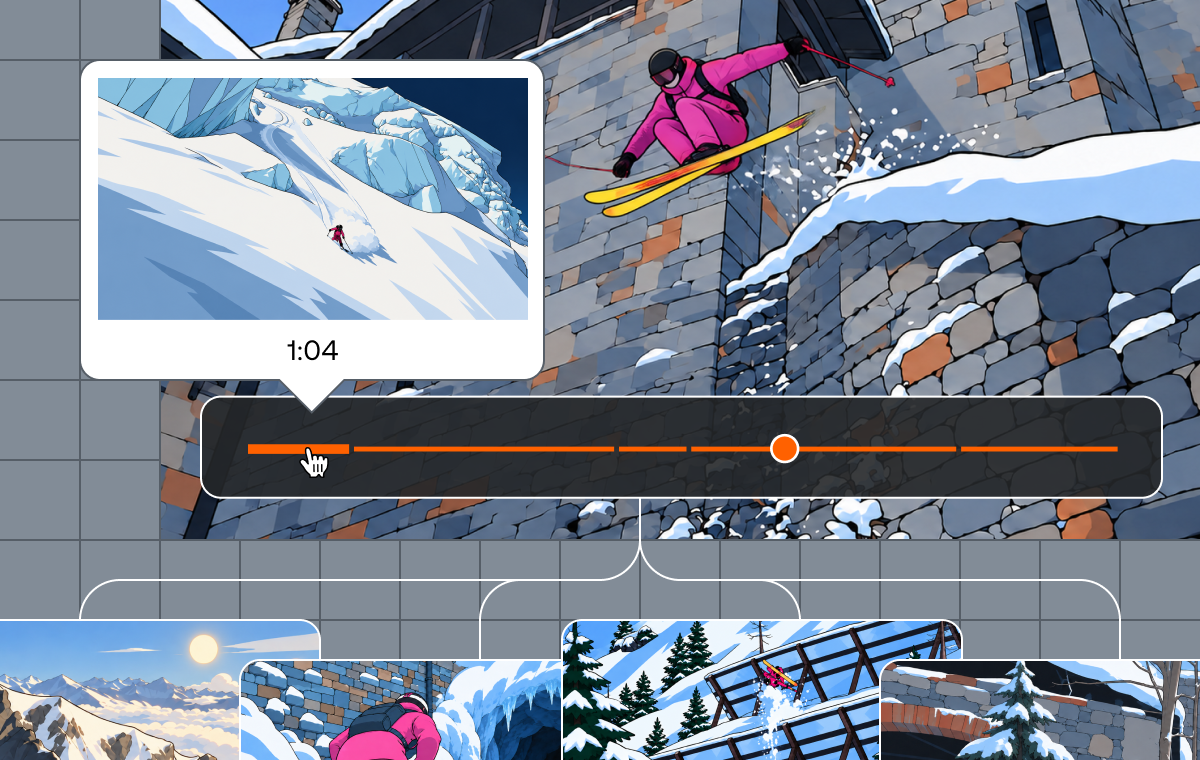
Industry benchmarks indicate that processing raw, unsegmented video streams through large multimodal models (LMMs) increases operational latency exponentially while inflating cloud computing costs. Consequently, video AI architects have prioritized pre-filtering frameworks. These systems ingest the raw media and apply lightweight programmatic checks to isolate the minimum viable subset of visual data necessary to accurately answer a specific query. By shrinking the input scope before engaging heavy machine learning models, developers achieve dramatic reductions in processing time and infrastructure expenditure.
Deconstructing Video Architecture: From Frames to Chapters
Modern video AI workflows do not treat a digital asset as a monolithic block. Instead, sophisticated pipelines deconstruct media into a hierarchical spectrum of granularity, ranging from microscopic static frames to macroscopic structural chapters.
Frames: Precision at the Microscopic Level
At the most granular level lies the individual frame. A single frame serves as the foundational unit for queries that require absolute spatial or compositional precision. Tasks such as automated content moderation—scanning for visual violations, nudity, or graphic violence—rely heavily on frame-by-frame analysis. Similarly, automated thumbnail generation algorithms evaluate candidate frames using weighted scoring matrices that factor in visual clarity, focal composition, facial prominence, and action intensity.
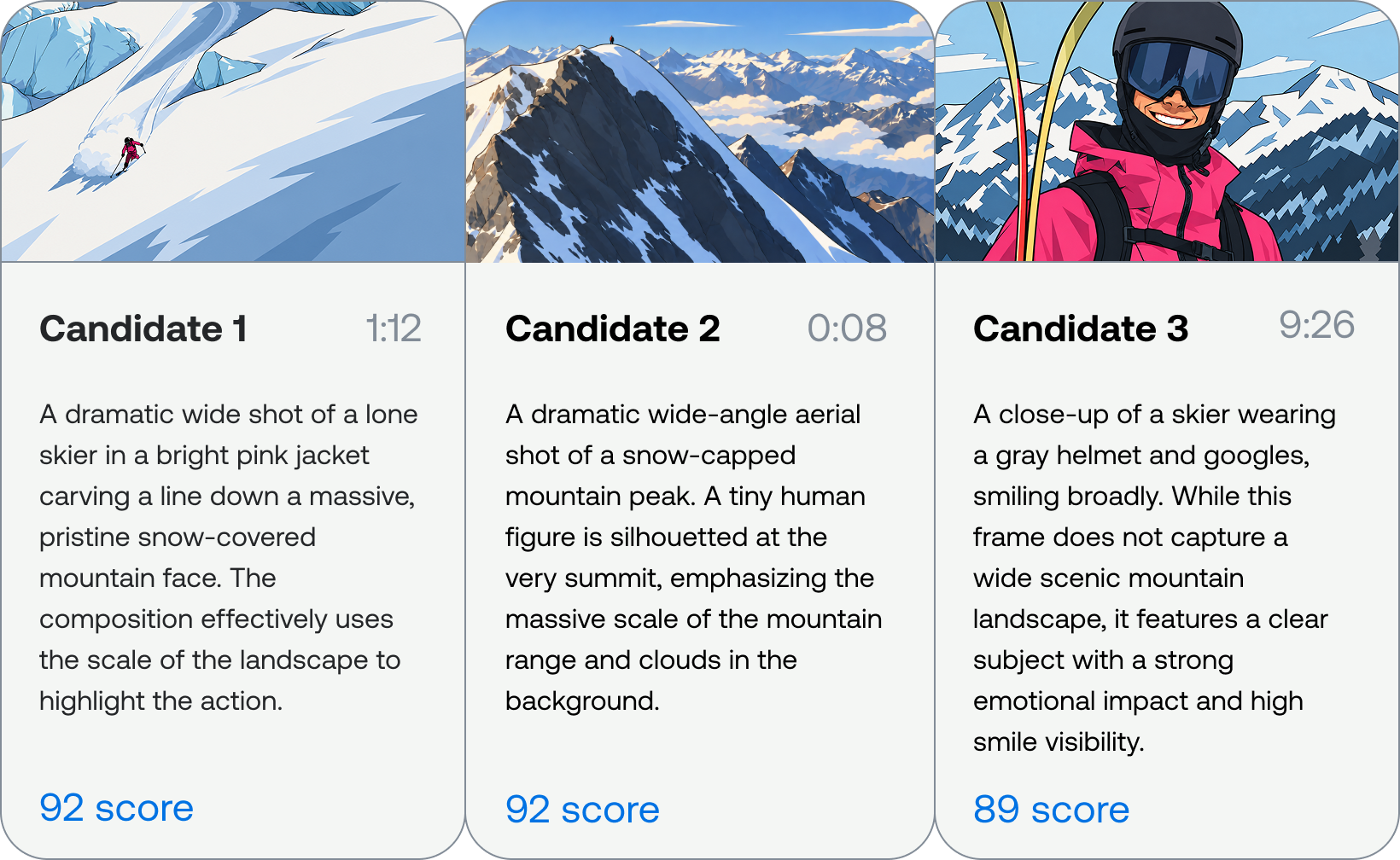
Despite their utility for static analysis, frames are inherently limited. A single image can capture a professional athlete suspended in midair at the apex of a jump, but it cannot determine whether the athlete successfully landed or what trajectory preceded the maneuver. Increasing the sampling rate of frames introduces massive computational overhead without necessarily resolving temporal ambiguities.
Shots: Capturing Visual State Transitions
To bridge the gap between static frames and continuous movement, video processing pipelines utilize shot detection algorithms. A shot represents a continuous take bounded by distinct camera cuts or scene transitions. By employing low-cost pixel-comparison algorithms, video processing systems can map out visual state changes without requiring high-cost vision models to inspect every intermediate frame.
Shot-aware sampling ensures that fast-cut content—such as rapid montages, multi-angle action sequences, or dynamic commercial spots—is adequately represented. Without shot boundary detection, uniform sampling intervals routinely skip over brief camera adjustments, quick pans, or sudden terrain shifts. However, while shots provide a reliable structural map of visual change, they still lack semantic narrative context. A shot boundary indicates when the camera angle shifted, but it cannot intrinsically explain the broader narrative significance of that transition.

Scenes: Establishing Narrative Cohesion
Moving beyond individual camera takes, scene detection groups neighboring shots that share thematic, narrative, or environmental continuity. Establishing a scene requires a synthesis of multiple data modalities. While visual boundaries provide the initial windowing parameters, audio tracks, spoken transcripts, and contextual cues are integrated to determine where a cohesive narrative sequence logically begins and ends.
In heavily visual content featuring minimal spoken dialogue, multimodal AI agents rely on visual clustering and environmental signatures to define scenes. For instance, transitional shifts in landscape, lighting, and overarching action style are synthesized into unified timestamps. This structural grouping allows downstream software applications and autonomous AI agents to retrieve entire thematic sequences rather than disconnected fragments of video.
Moments and Chapters: Product-Facing Navigation
At the macroscopic level, system architectures deploy key moments and chapters to satisfy user-facing product requirements. While scenes describe the mechanical makeup of the media, key moments identify standalone, high-value excerpts—such as a specific athletic trick from approach to landing—that possess enough internal context to function independently as shareable clips.

Chapters, conversely, serve structured navigation purposes. By dividing a protracted video asset into a logical table of contents, chapters enable viewers and automated navigation tools to jump directly to specific thematic blocks. While transcript-based metadata typically drives chapter generation in spoken-word media like podcasts or lectures, visually driven media relies on environmental shifts and structural scene detection to populate these navigational indexes.
Practical Implementation: The Ultimate Run as a Case Study
To evaluate the efficacy of hierarchical video parsing in practice, engineers frequently test workflows against complex media assets. A prominent example utilized in technical evaluations is Markus Eder’s acclaimed skiing film, The Ultimate Run. Spanning approximately ten minutes, the production seamlessly transitions through high-alpine powder fields, subterranean ice caves, glacial crevasses, urban architecture, and industrial spaces, edited to create the illusion of a single, continuous descent.
The film presents a rigorous stress test for multimodal AI architectures due to its high-velocity action, rapidly changing environments, and near-total absence of spoken narration. When processed through a modern video AI pipeline, the asset yields approximately 18,000 distinct frames, bounded by 159 structural shots and 7 distinct narrative scenes.

When a user submits a retrieval query—such as identifying the precise sequence where the subject navigates an ice tunnel—the system must determine the appropriate level of granularity. A whole-video recommendation is insufficiently precise for direct playback navigation, while an isolated frame lacks spatial context. By leveraging embedding vectors derived from multimodal chunks, the system cross-references textual search prompts against visual and structural metadata, successfully isolating the exact temporal range corresponding to the user’s query.
Implications for the Future of Digital Media Infrastructure
The architectural shift toward granular, question-driven video analysis has profound implications for the broader digital media ecosystem. As artificial intelligence agents assume increasingly autonomous roles in video editing, compliance auditing, automated ad placement, and accessibility description generation, the demand for efficient data ingestion will only intensify.
Industry analysts note that the scalability of next-generation video platforms will depend almost entirely on their ability to minimize redundant computational processing. By establishing strict protocols that route queries to the smallest possible video subset containing the necessary context, developers can mitigate the environmental and financial costs associated with large-scale model inference.

Ultimately, the dichotomy inherent in processing complex video assets—balancing microscopic precision against macroscopic narrative structure—underscores a broader truth in modern software engineering. More context is not inherently better context. Efficiency is achieved not by ingesting every available data point, but by deploying the exact level of granularity required to answer the specific question at hand.